
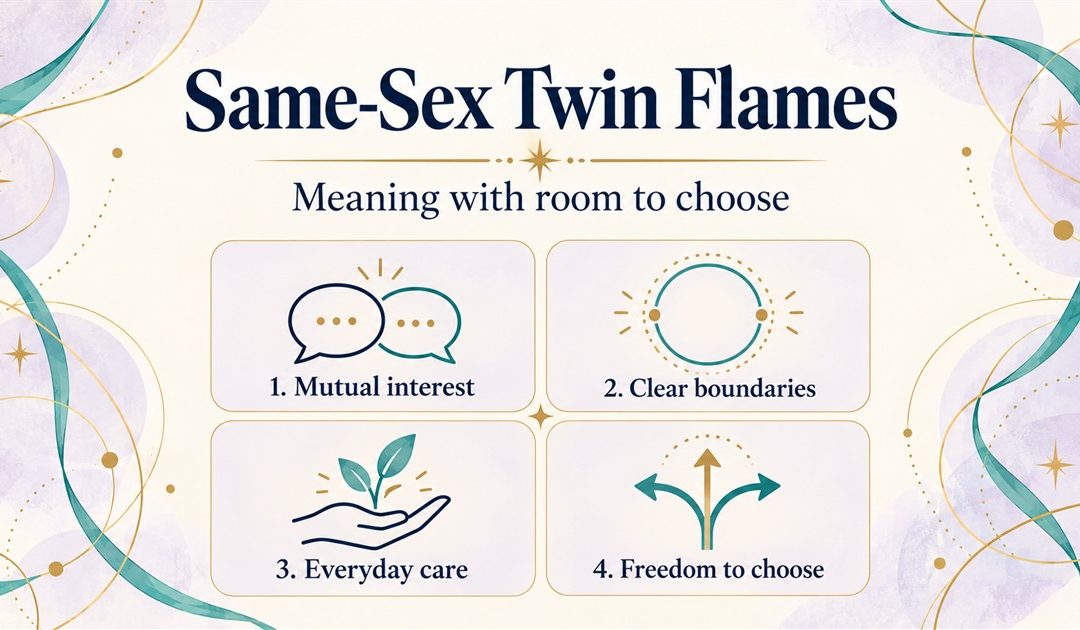
Can two people of the same sex be twin flames? If that spiritual language fits your beliefs, the connection does not need a man-and-woman pairing to be meaningful. The label is optional, and it cannot establish another person’s feelings or require a relationship.
People use twin flame in different ways: a mirror for personal growth, a shared-soul story or a name for an unusually powerful bond. There is no agreed test that identifies one person as your only possible counterpart. You can hold a spiritual interpretation while getting to know the person in front of you.
Connection does not require fixed gender roles
Some teachings use divine masculine and divine feminine as symbolic language. You might connect those ideas with initiative, receptivity, structure or care. None of those qualities belongs exclusively to a gender, and two partners do not have to divide into opposite roles to validate their bond.
You can also leave those terms out. Asking “Who gets to make decisions?” or “How do we each like to receive care?” may tell you more than assigning an energy label. Identity, body and orientation can be important parts of a person’s experience; a spiritual story should not erase them.
What if the connection changes how I understand attraction?
You may feel unexpectedly close to someone who does not fit the pattern of your earlier attractions. That can be something to explore at your own pace. It does not require choosing a new label, beginning romance or proving that your previous identity was mistaken.
Affection can remain friendship. Curiosity does not establish sexual interest, and a deep feeling from one person does not create a mutual relationship. Ask about what is welcome and accept the answer, including uncertainty or a no.
Dreams and past-life beliefs can remain personal
A dream of a familiar person in another body may feel significant. Some people interpret that through reincarnation; others see it as imagination, association or a story their mind is exploring. It does not verify an earlier lifetime or identify a stranger you should pursue.
No reader can establish that a past life explains your orientation or gender. Avoid a story that makes your present identity a mistake to correct, or tells you that harm was chosen as a spiritual lesson. You can value the meaning without surrendering your own account of who you are.
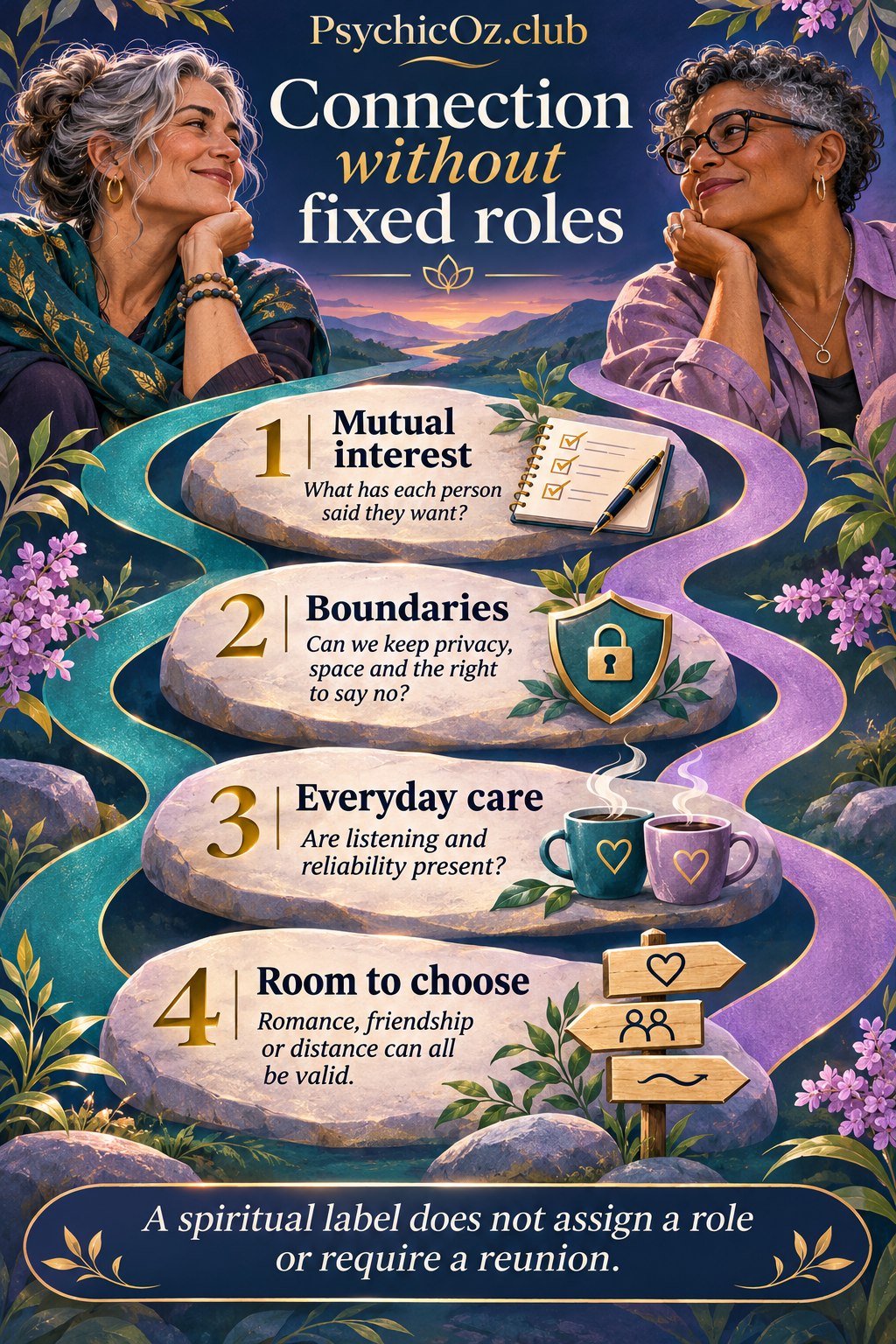
Four questions that keep the relationship in view
1. Is interest mutual?
What has each person actually said they want? A supposed telepathic message does not overrule a clear answer.
2. Can we keep boundaries?
Privacy, time apart and a request for no contact remain valid even when the bond feels extraordinary.
3. Is there room for ordinary care?
Look at reliability, listening and how disagreements are handled. Intensity is not a substitute for respect.
4. Can growth take different forms?
You may choose romance, friendship, distance or another direction. Development does not require reunion or an enduring partnership.
Our healthy gay relationships guide offers a practical check-in alongside the spiritual question. Its everyday principles can help you discuss what you both want without needing a cosmic verdict.

Free roles-and-choice reflection card
- The meaning I give it: What does twin flame describe for me?
- The role I am assuming: Am I assigning someone a trait, a gender role or a future they have not chosen?
- The actual agreement: What have we both clearly said yes or no to?
- The next choice: What would respect each person’s identity, privacy and wishes now?
Example: “I experience this as a spiritual bond. They want friendship. I can decide whether friendship works for me without treating their answer as a temporary obstacle.” You can use the card privately; it is not a test to administer to another person.
Choose support that respects your identity
A welcoming reader should use your name and language, keep personal details private and avoid promises to change your orientation or force someone to return. Check fees and methods before booking. You are free to disagree with an interpretation or stop.
Pressure, monitoring, threats or a demand to prove the bond by surrendering a boundary deserve attention. Love is respect’s boundary guidance focuses on expressing needs and limits without fear. Seek confidential support when needed, and use local emergency help for immediate danger.
A spiritual connection can add meaning to love without becoming its rulebook. You do not need to balance yourself perfectly, adopt assigned energies or accept one fixed relationship outcome to deserve care.
Frequently asked questions
1. Can twin flames be people of the same sex?
If that language fits your beliefs, you can use it for a same-sex connection. It does not establish another person’s wishes or a destined outcome.
2. Is there only one twin flame for each person?
Beliefs vary, and there is no reliable test that establishes one exclusive counterpart or a universal soul system.
3. Must one partner be masculine and the other feminine?
No. Those are optional symbolic terms, not required gender roles or a test of a relationship’s validity.
4. Can I use no energy labels at all?
Yes. You can discuss care, decisions, boundaries and attraction in your own words.
5. Does an unexpected attraction mean my identity was wrong?
No. You can explore a feeling without being forced to change a label or deny your earlier experience.
6. Can the connection remain a friendship?
Yes, if both people want that. A spiritual interpretation does not create romantic or sexual consent.
7. Do dreams prove a past-life connection?
No. You can value a dream while leaving its literal explanation uncertain.
8. Can a reading explain my gender or orientation through past lives?
It cannot establish that claim. Your identity is not a problem for a reader to diagnose or correct.
9. Must we reunite for the journey to be complete?
No. Growth does not depend on another person returning, and separation is not proof of spiritual failure.
10. Can I contact someone who asked for distance?
Respect the boundary they communicated. A twin-flame story is not permission to pursue unwanted contact.
11. Does intense emotion prove compatibility?
No. Consider actual behavior, mutual wishes and room to disagree rather than intensity alone.
12. Should a reader decide which role I should play?
No. You can reject imposed roles and keep decisions about your life with yourself.
13. Do I have to be perfectly balanced before finding love?
No. There is no spiritual-perfection requirement for deserving care.
14. What if the label makes me feel trapped?
You can change or stop using it. A meaningful experience does not create a duty to stay in unwanted contact.
15. What can I reflect on without a reading?
Consider the meaning you give the bond, the roles you may be assuming, the actual agreements and a next step that respects both people.